Encounters with Artists
“On the idea that the moment of creation, whether a work of art or person, carries the uniqueness of the moment in its character”. — Nietzsche Zarathustra
Painters are famously recalcitrant to talk about their work, as if talking will dry up the creative source. The female surrealist painter, Leonora Carrington, when questioned about her art, was known for her enigmatic and often self-referential responses, often expressing a desire for her work to be ‘experienced’ rather than ‘analyzed’. What takes place behind the scenes – the process of painting – is difficult for artists to transcribe in words. Painting is a different language altogether, and words leech from its essence. If we think of the artwork as a receptacle, containing inside it the fleeting jolts of inspiration but also timelessness, Rimbaud’s quote ‘I is another” becomes a way of putting the creative act in words: I is elsewhere, something is speaking through me that is not me.
Art-making is mystical, and it is best when left a mystery. In the work of my teachers, the paintings that have ‘texture’, what Maria Rosa refers to as ‘chispa’, are the ones that touch life, with the power to awaken the sleeping imagination. How many of us have stood in front of an artwork and felt flat, or contrarily found an artwork that moves us deeply but in ways we can’t explain in words? A painting does not reside in the domain of the articulatory. It contains the essence of the creator, or better said the essence of the moment in which it was created. This is one of the beauties of a painting: it is both a moment and an eternity woven into a single image. Whatever it is that has captured the artist at some definitive moment works through them and can leave generations of viewers spellbound, like with Vermeer’s ‘Girl with the Pearl Earring’. The fact that this work is a mystery, that we have lost the keys that unlock its meaning, make it all the more alluring.
I have had the great privilege to work intimately with three artists who could not approach the practice of art-making more differently, despite leading interwoven lives. The work of Ivonne Kennedy, with whom I have had the longest relationship, has gone through many stages, but there is a quality in her work that makes it seem as if each piece were created through acts of sorcery. The glimmers of metallic sheens, unusual pigments, optical illusions, gold and silver leaf, asphalt, these are all examples of some of the materials she uses regularly in her creative ‘concoctions’. When Ivonne paints she is engaged with the artists’ materials, and her work holds the uniqueness of the moment in which it was created. She plays music and the atmosphere of her studio, with its mystical accoutrements, find themselves interwoven in her work. I see her work as time-capsules, containing inside of them the essence of the moment, the hour, the synchronicities that gave it life. Like her barcos y navegantes – boats and travelers, a recurrent motif – her work travels through space-time trying to recover reminiscences.
Describing her creative process as intuitive, ludic, Ivonne is headful of synchronicities. Once when I was frustrated with my own work, making angry jabs at the canvas, she showed me one of her own particularly complex works, a story, containing within it all the evolutions it underwent. She said “regale a cada etapa el debido respeto, y deja que se te revela en su momento” (give each stage its due respect, and let the process reveal itself in time). To me this anecdote hints at what takes place behind the scenes. For Ivonne, everything that arises in the moment of creation – accidents, spills, detours, distraction, fortuitous encounters – are part of the process that will reveal the work in time. She has dozens of painting-tubes, countless tools, and a studio filled with esoterica. In communion with these objects and the artists’ materials, her work makes itself manifest. She works in her studio routinely for 6-8 hours a day. For her inspiration comes while she is working.
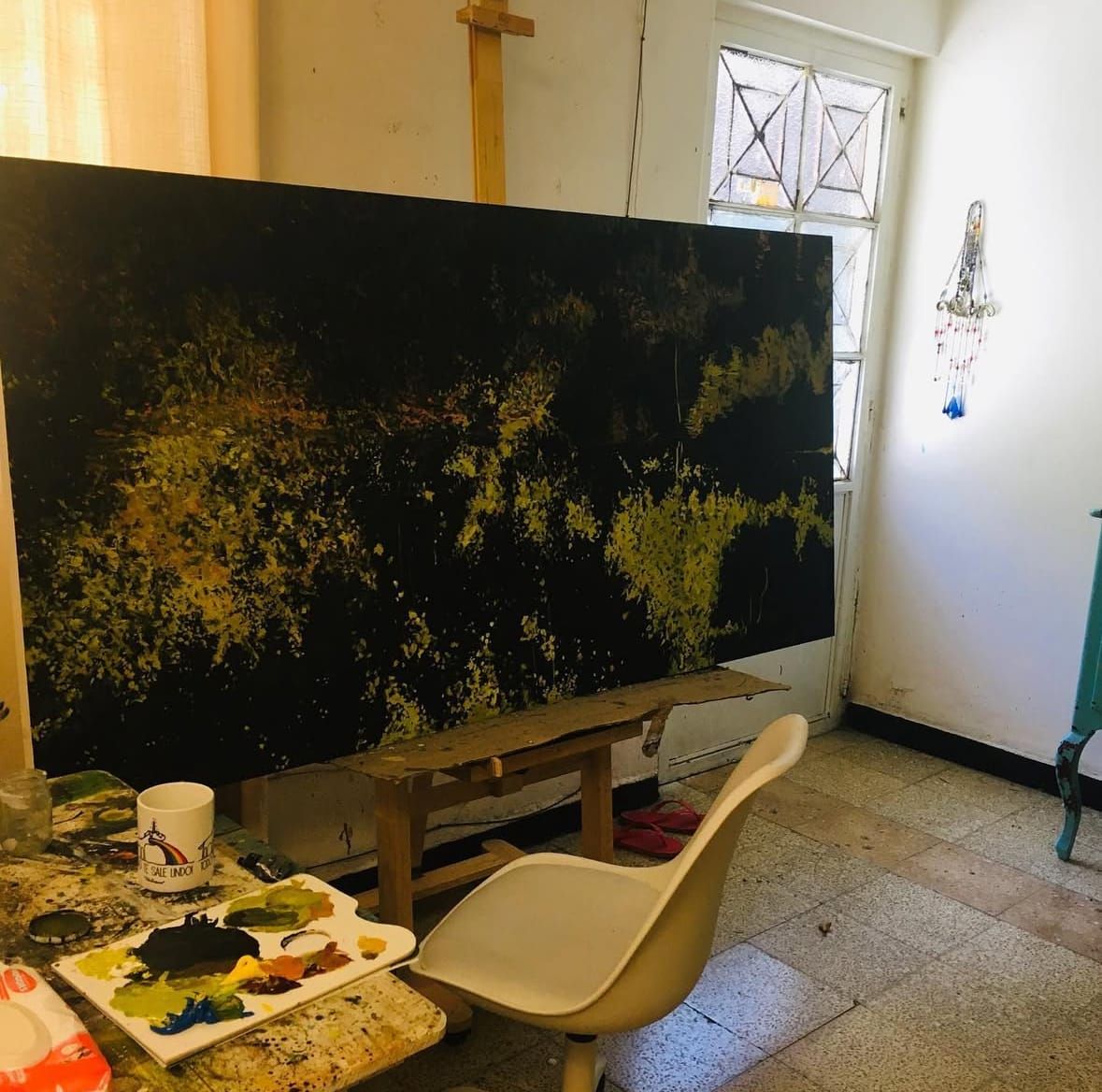
Every Tuesday and Thursday from 5pm to 7pm, I go to painting classes with Maria Rosa Astorga at her home-studio in the Centro Historico of Oaxaca. “Hija del exilio”, as she likes to say, Maria Rosa was born in Chile, and then exiled with her family when Pinochet came to power. She has lived for the past 32 years in Oaxaca. When asked about her painting, she describes herself not as an ‘artist’ but as a ‘paisajista’ – a landscape painter. Thirty-two years as a working artist and all the work she displays publicly have been landscapes, largely rendered in oil, but she also makes work in watercolor and printmaking. “ I have always been interested in discovering where painting veers into the scientific – what is resolved through a method,” she said. In her work she has achieved a photorealistic effect through mastery of her medium, but her work is by no means sterile: her serene scapes possess soul, uniqueness. There is a melancholy aspect to her landscapes, perhaps because she is representing fleeting beauty, or maybe it is some trace of her own feelings she has left onto the piece.
“Ask yourself why you paint and have an answer even if it’s only for yourself” she says to each of her students. For a curriculum we spend weeks learning color, guided by Johanne Itten’s book, The Art of Color. Itten, known for his teaching at the Bauhaus, was “an oddball who sported monks' clothes, ‘the bauhaus frock’” Maria Rosa jokes. The first exercise I ever did was to build a complete color sphere using only the three primary colors, white, and black. For Itten “...color lends spiritually realized sound to a form”. Perhaps this is the secret to Maria Rosa’s paintings; her mastery of color, light, and composition bring a spiritual atmosphere to her work. In her small casa-studio, she has only a few brushes and five tubes of oil paint – red, blue, yellow, black, and white – through which she renders the infinite colors and varieties of nature. I asked her once why she only paints nature, and she answered that life is already full of terror and pain and human beings too complex to render two dimensionally (note she is a master of her medium, the shortcoming she alludes to is not due to technical skill, it is the emotional weight she speaks of). In her paintings she seeks tranquility, and I suspect there is also an element of recovering reminiscences, because many of the natural scapes she paints are of Chile, her motherland from which she was exiled. When I asked her about Chile, it was the land she described most vividly, the immense range of the Chilean topography, ranging from the dry Atacama desert to the icy glaciers and fjords of Patagonia in the south. The tone she assumes when she speaks of her homeland is most revealing. In Pedro Paramo, Juan Rulfo wrote of the reminiscences of the protagonist’s mother, Dolores, that “cada suspiro es como un sorbo de vida del que uno se deshace”. I always think of this when I hear Maria Rosa speak of Chile: a nostalgia laced with sighs. Her tranquil landscapes, lying bare and unpopulated, often clouded by mist, also reveal a subtle sadness, a sense of melancholy. Forgive my projection, but I think the artist has left in her paintings a touch of her yearning, her grief, her forced exile, her search back to a now extinct motherland.
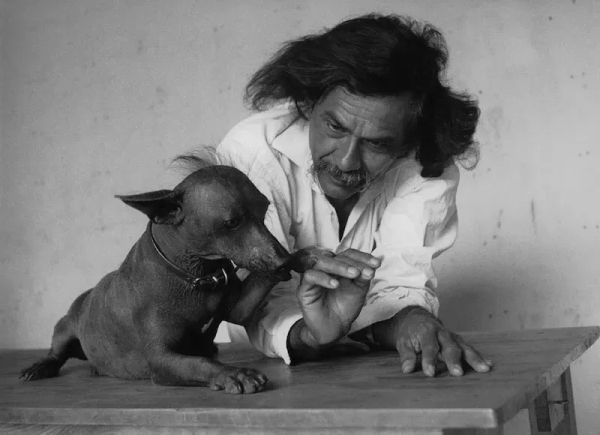
The life of Raúl Herrera, who is now in his mid 80s, resembles something of the bohemian fantasy of 1920s Paris. Born to a working-class family in Mexico City, Raúl’s family was active in the Mexican Revolution and connected to the ideals of the working class. Eighteen years younger than his closest sibling, Raúl said that his childhood was a lonely one, and he found solace in art. He drew constantly. He often says that he grows bored easily, but with art “nunca me aburro”.
Both his parents supported Raúl pursuing the arts, but it was his mother who exposed him at a young age to the intellectual circles of Mexico City, including that of Frida Kahlo, and pressed him to pursue the arts seriously. This period between the 1930s to the 1950s was a very exciting time in Mexico. It was a period of cultural and artistic flourishing. Mexico City had become a mecca for the exiled European vanguard, with surrealists such as Andre Breton declaring Mexico to be "the most surrealist place in the world" and bringing with them their own artistic traditions. In the Post-Revolutionary period, government sponsorship led to the predominance of politically themed figurative art, known as social realism. The works of the muralists Diego Rivera, Alfredo Siquero, and Jose Clemente Orozco were emblematic of this moment in Mexican art, and created a lasting artistic tradition for ensuing generations of Mexican artists. Raúl’s formal artistic studies began at the Academia de San Carlos, during which he was encouraged by his father and his teachers to concentrate on artwork with political and historical messaging that would appeal to the proletariat. He did so, but in time he found his interests shifting with the times, with the realities of a nation forging its modern identity. He became involved with the Rupturistas, a group of Modern artists of the Post-Revolutionary period in Mexico who sought to deconstruct the inherited patterns of Mexican muralism and introduce an entirely new visual vocabulary. In 1973 he exhibited at the Museo de Arte Moderno de la Ciudad de México, where he was awarded the Premio de Adquisición del Salón Nacional de Pintura de Bellas Artes. Later he went to Paris where he studied at Beaux Arts de Paris, and returned to Mexico City sometime later, traveling extensively in the interim, before settling in Oaxaca in the 1990s.
Describing his early work, Raul was influenced by abstraction, creating pictorial expression directly through line and color. The Rupturistas, which emerged as a fledgling movement of Expressionism, similarly sought to break away from reality and build a visual vocabulary directly through the composition. Later in life, contact with Mexico City and San Francisco’s Chinatowns would expose the painter to Oriental art-making techniques and calligraphy which would forever change his relationship to painting and artist materials. Through Oriental art-making techniques and calligraphy, Raúl exalted the powers of gesture. His signature light, fluid, and highly gestural brushstrokes have distinguished his pictorial universe from other artists of his generation.
Why probe so much into the inner sanctuary of the artist? In his autobiography, Diego Rivera spoke of how he came to realize his vision of social realist art, an art that would serve the masses and reflect Mexican society. Rivera describes how from the beginning he was certain of his vision, certain of a ‘quality’ in his work, but he lacked the visual vocabulary (elsewhere called ‘style’) to channel this vision into form. Through his studies in Academia Real de San Carlos (he mentions in particular Santiago Rebull and Jose Maria Velasco as early mentors) and later in Madrid under the guidance of Eduardo Chicharro and Juan Sorollo, Rivera learned an academic style of art that, while provided him with the elemental techniques of painting, left him empty and greatly dissatisfied. In Paris he found himself at the pulse of the artistic avant-garde and, through friendships with people like Picasso and Ambroise Vollard, began to develop his own cubist art. Of cubism Rivera said “as the old world would soon blow itself apart, never to be the same again, cubism broke down forms as they had been seen for centuries, and was creating out of the fragments new art forms, new objects, new patterns, and, ultimately, new worlds” (pg. 58). But ultimately it was in “his soil” that he needed to return to make his social realist vision for art a reality. An early mentor of Rivera’s, the master printmaker Guadalupe Posada, was instrumental in showing a young Diego “the supreme lesson of all art – that nothing can be expressed except through the force of feeling, that the soul of every masterpiece is powerful emotion” (pg. 18). I incorporate this story of Rivera because he is a fixture in the lineage of Mexican painters, and his musings on his lifelong devotion to his calling are most enlightening. Just as Rivera had many evolutions and stages in his painting career, a constant refining of the tools and materials through which to channel his vision, so have Ivonne, Maria Rosa, and Raúl demonstrated equal devotion to their life’s calling.
What distinguishes the work of these mature artists is the sensitivity to what Rivera called “the force of feeling” and what others might call quality or texture. The pictorial worlds created by these artists are individual to each, and their process reveals something of that individual force that is captured in their work. As a student of art, in the process of refining my techniques and discovering the essence of my work, I find the study of the process of the masters and my mentors to hold clues to what distinguishes a work of quality (an impossible task!). By observing the process of my teachers, I see how they have established their own traditions within art. Art, a word so abstracted and connoted upon we lose all bearings as to what it really means, is a live, mercurial thing, and it is through inroads made by painters like Ivonne, Maria Rosa, and Raul, that from the very word art, like a coiled spring, tumbles forth a lineage.