Oaxaca, Art, and Art Patrons
I am constantly humbled by the privilege of making art in Oaxaca, where I find myself again and again just happening to be in the presence of incredibly talented artists. Often I wonder how it came about. How did this ex-colonial city in southern Mexico become such a haven of so many great artists, working in so many mediums? I remember a recent conversation with Nancy Mayagoitia, one of the leading art patrons in Oaxaca, Mexico, and curator of the exhibit “Watermelons and Color: The Legacy of Rufino Tamayo”, who was sharing her take on what she considers to be some of the key elements that have allowed the arts to flourish in Oaxaca. She told me “[i]t’s partly because of the creation of cultural legacies thanks to the work and philanthropy of major figures including Rufino Tamayo, Francisco Toledo & Alfredo Harp Helú, but it’s more than that. Many lesser known individual art patrons are also focused on Oaxaca and have helped generate opportunities for a new generation of Oaxacan artists, creating new avenues for artistic output.” Nancy's recent exhibit is a perfect example, building on the legacy of one of the greats to bring inspiration to a current generation of artists.
There are many factors that have contributed to the robust arts scene in Oaxaca. Many visual artists cite the quality of the light, the colors, the shapes and images of the region. The influence of the ancient and colonial heritage of the city, its rich craft traditions, and the large population of talented young artists are all important components. The number and quality of taste of patrons, collectors and galleries that both nurture and have grown in response to the quality artists are also key. But there is an overarching influence from the legacy of Francisco Toledo. He is everywhere. When I am exploring mediums and themes for pieces, I am constantly surprised to find him, not as a static influence emanating from his artworks, but as someone who actively set up resources to help future artists discover new things and create work.
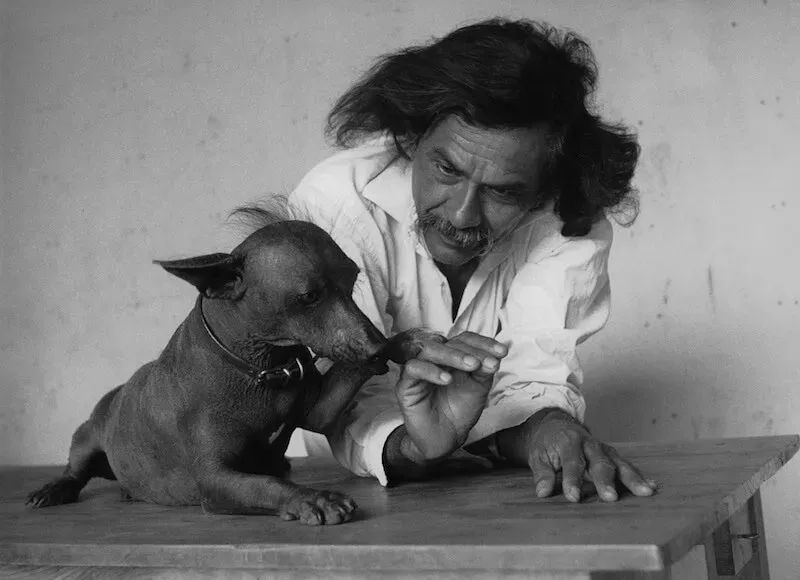
Raised in Juchitan, a town in the isthmus of Oaxaca, a place already steeped in myth from the rich Zapotec lineage and their belief in Muxes (people of three genders), Toledo’s work was suffused with shamanistic animal imagery that drew on his Zapotec heritage. The scorpions, grasshoppers, alligators, monkeys and tapirs that he encountered in his childhood appear in his art as symbols and metaphors, alluding to everything from sex and fertility to a dying natural landscape. Raúl Herrera, a Mexican artist and friend of Toledo’s (Herrera was the youngest of the Rupturistas, a movement that sought to break away from the "tyranny" of muralists like Diego Rivera and David Siqueros), recalled a compilation of Toledo's erotic works published posthumously and said “his work was charged with sexuality, but in a way those of us outside of the Zapotec tradition can’t really grasp. The imagery of Zapotec folklore is sensual and enigmatic.” Toledo's arresting work brought him success, and he applied that success and his incredible energy - he was constantly producing work along with his many activities - to the preservation and galvanization of Oaxaca’s art and cultural scene. Toledo founded a multitude of artistic and cultural/environmental organizations in Oaxaca, such as the Instituto de Artes Graficas across the square from the Iglesia Santo Domingo which houses more than 7,000 prints and 25,000 books and is considered among the most important art libraries in Latin America. He also founded the Oaxacan Museum of Contemporary Art, the Jorge Luis Borges library for the blind, and a botanical garden. He was a key part of the Manuel Bravo Photography Institute, and his CASA Institute, a museum and art complex built from a converted textile factory in the idyllic village of San Agustín Etla, is an incredible space that sponsors and hosts exhibits, workshops, concerts, events, artists-in-residence and collaborations with international artists and organizations. He also spearheaded efforts aimed at preserving Oaxaca's native corns (maize) and keeping out GMOs. He was always politically active. As a small example, he was a leader of the effort that successfully kept a McDonalds off of Oaxaca's beautiful colonial Zocalo. Though entirely uninterested in celebrity, in the city of Oaxaca the stature of Toledo has taken on almost mythic proportions. In Oaxaca he is known simply as “El Maestro”.
One of the wonderful things in Oaxaca is the way El Maestro's legacy is a living one. His energy did not pass with him, but is carried on. Artists and patrons in Oaxaca follow his example, putting energy beyond their own works or individual interests to help galvanize a thriving scene. As one example, of which I have been privileged to be a part of, the Oaxacan artist Ivonne Kennedy in 2016 had a vision to build a guild of female artists, working collaboratively, as an alternative to the historically male-dominated art scene in Oaxaca. This led to the establishment of the GUENDA Collective, a group of 25 women artists of different nationalities and ages, who have exhibited collectively throughout Mexico as well as in the United States and Europe for the last eight years. GUENDA is an example of building connections and legacies of women artists who have worked in Oaxaca to the larger world. The current exhibition of the GUENDAs, “Constellations and Supernovas”– which took place at Casa de la Cultura in Oaxaca from October 6th, 2024 to December 6th, 2024 and then at Universidad Autonoma de Mexico (UNAM) in Mexico City– commemorates the lives of Nadja Massun (1963-2022) and Sara Jacinto (1995-2022) whose work is featured posthumously in the exhibit. Sponsored in collaboration with the astronomy department at UNAM, the SLOAN Digital Sky Survey, and the first ever NASA Apps Challenge in Oaxaca, this exhibit intersects science and art. It has resulted in new and unexpected connections, as well as the introduction of new thematic elements into the vast oeuvre of Oaxacan art.
Toledo created the institutions through which young artists can cultivate knowledge, technique, and appreciation of the arts. In this fertile space, artists, art patrons, and institutions intersect, laying the seeds for new types of creative propositions. In this way, new mediums are discovered, old techniques reclaimed, and a fluid exchange of ideas from other cultures and artists has introduced whole new thematic elements into paintings.